Between 8-16 weeks is the perfect time to teach your puppy to walk with you off leash. The puppy is very insecure at this stage and will naturally follow you like he would his mother. So take advantage of teaching him that you are the leader.
To do this, take your puppy to a safe place. A place where he can walk off leash without any danger of cars. Perhaps an enclosed park or wooded area is best. Walk along and let him follow you. If he wanders in another direction, resist the urge to go after him. In fact...you should never chase your dog at any time. That becomes a game of chase that will be a great reward for his running off. Don't do it! Instead walk more quickly away from him. The younger he is, the closer he will stick with you.
As he grows older he will be more and more independent. At some point he will just wander just out of sight. At this point, (if you are in a totally safe place), hide from the puppy. As soon as he notices you are not around, he will worry and try to find you. As soon as he finds you, give him a treat from your pocket. Praise him and make a big deal about his being lost and being so good to find you.
For this to work, you have to be at the exercise consistently from the time they are young. You don't want to take an older dog out and hide....without any preliminary practice...otherwise you just might not find him again!
If you make the effort to find a time and place for this exercise, from the beginning of 8 weeks and on...your puppy will be much safer in the long run. If he should get out the door, or you should drop his leash, you won't need to worry that he will run away. He will be convinced that his poor mom is very prone to getting lost and he had better keep his eye on you or he will lose you.

Virginia Breeder of Schnoodle puppies - a non shedding, hypoallergenic dog breed.
Tuesday, September 28, 2010

Monday, September 27, 2010
Nibbler's family comes to get Chloe!
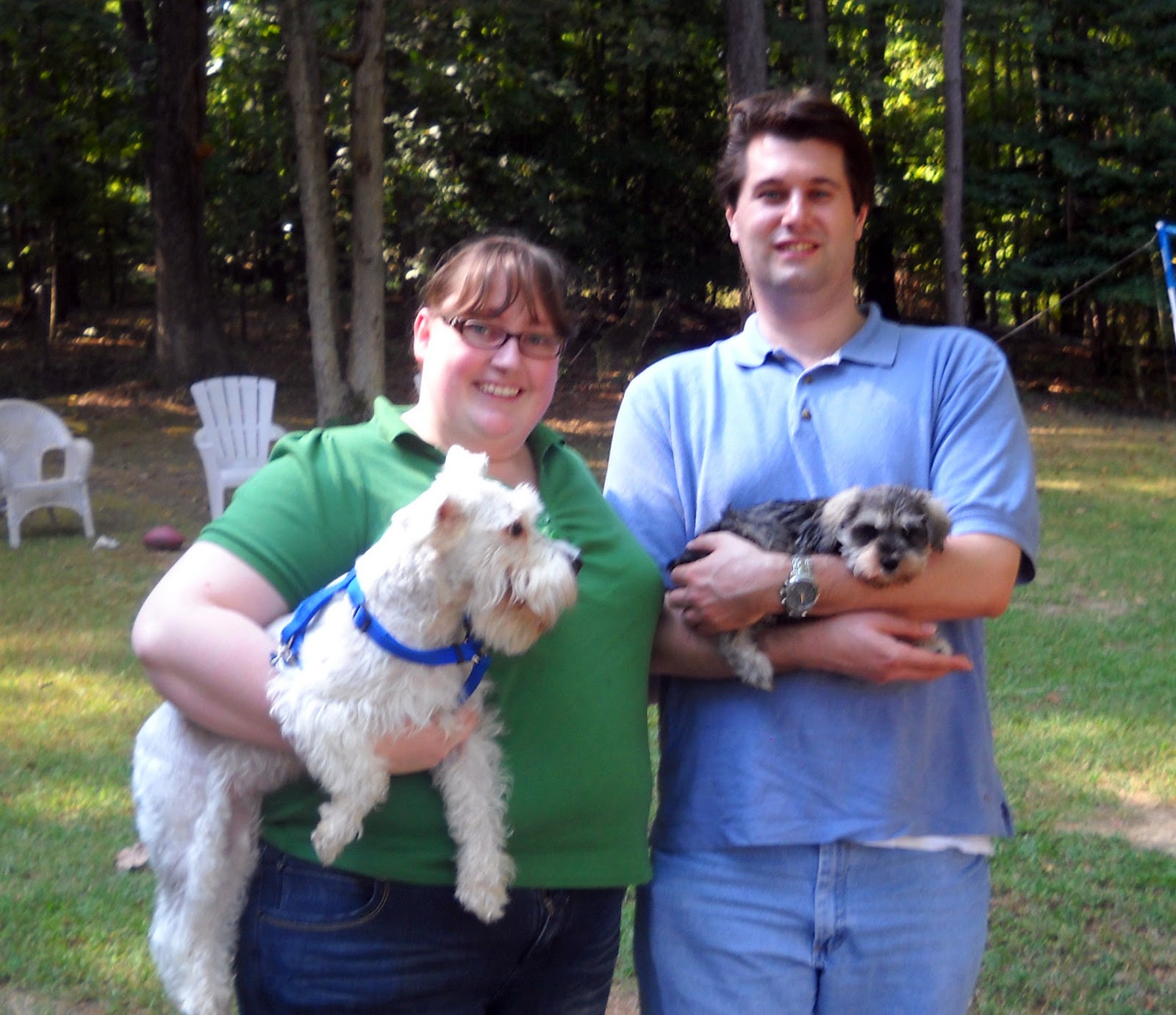
On Friday of last week, Nibbler from last years litter came with his family to pick up Chloe. It was so awesome to see how beautiful Nibbler had grown up to be. He was so friendly and excited to be here. Of course, I highly doubt that he would actually remember us. But it was almost as if he remembered Dixie!
 |
| A happy family! Nibbler sure looks excited to meet Chloe. |
 |
| Nibbler has a beautiful white silky coat. |

 |
| He was so excited to visit Dixie. |
 |
| Look at this handsome boy!! It makes a breeder proud! |

Last week....our last pup photos!
The pups were so much fun last week, as they were at the peak of their energy right before they left us. It was hard to photograph them because they didn't stay in one place too long. Nonetheless, we managed to take a few pictures of them. So here are the last photos of our pups before their new families came....


 |
| Group Hug! |

 | |
| Jet enjoys a back scratch. |
 |
| Chloe plays with my son. |
 |
| Coco wants some love. |
 |
| Yoshi found a little rope in the grass. |
 |
| Max at 7 1/2 weeks. |
 |
| Dixie still allowed the pups to nurse for very short periods of time. You can see how big they have become, next to her. |

Friday, September 24, 2010
Low Blood Sugar- Be Aware!
Some dogs, especially smaller breeds can be susceptible to stress, which can cause a condition of low blood sugar, called hypoglycemia. In small breed puppies from post-weaning to 4 months of age, the most common form of hypoglycemia is called Transient Juvenile Hypoglycemia. Even a brief period of fasting in a small breed puppy can trigger a hypoglycemic "attack."
What are the symptoms: One of these attacks may appear as weakness, confusion, wobbly gait, or seizures. Additionally if your puppy is lethargic, listless, or not interested in eating, stress and low blood sugar may be the cause.
What to do: If your puppy appears to have an attack, a small dose of Maple syrup may help your puppy recover. Do not wait to administer, as the puppy may not make it to the veterinary. In severe cases intravenous glucose administration is required.
Stress and hypoglycemia can cause dehydration and can lead to death. If your puppy shows signs of stress, you can use a quick remedy for this: Pedialyte (or generic electrolyte replacement formula) can be purchased at WalMart and is an effective quick remedy for stress & hypoglycemia. Gatorade or similar electrolyte sports drinks can also be utilized. Even a quick remedy of plain sugar water can be used, if you don’t have anything else available. If he will drink the fluids on his own, allow him to do so!
Please note: Improper administration of fluids by syringe or any other means can result in choking or aspiration and can lead to aspiration pneumonia.
What are the symptoms: One of these attacks may appear as weakness, confusion, wobbly gait, or seizures. Additionally if your puppy is lethargic, listless, or not interested in eating, stress and low blood sugar may be the cause.
What to do: If your puppy appears to have an attack, a small dose of Maple syrup may help your puppy recover. Do not wait to administer, as the puppy may not make it to the veterinary. In severe cases intravenous glucose administration is required.
Stress and hypoglycemia can cause dehydration and can lead to death. If your puppy shows signs of stress, you can use a quick remedy for this: Pedialyte (or generic electrolyte replacement formula) can be purchased at WalMart and is an effective quick remedy for stress & hypoglycemia. Gatorade or similar electrolyte sports drinks can also be utilized. Even a quick remedy of plain sugar water can be used, if you don’t have anything else available. If he will drink the fluids on his own, allow him to do so!
Please note: Improper administration of fluids by syringe or any other means can result in choking or aspiration and can lead to aspiration pneumonia.
Health Guarantee and Preventative Care
We guarantee that your puppy will be sent home with you healthy and free of diseases to the best of our knowledge. We have had a recent veterinary good health report to further ensure the health of these puppies for you. If you take your puppy to a licensed veterinary within 3 days after your date of purchase and the vet finds an unforeseen congenital abnormality, it is your options to return your puppy for a full refund. You must present to us a written health report from your veterinary stating the defect.
If your puppy is exposed to an infectious disease after it leaves here, we cannot be held responsible, and this is not covered under the health guarantee.
We also cannot guarantee that your puppy will never develop any health problems, just like a pediatrician cannot guarantee that a child will never develop any health problems in the future. Some things are just not able to be predicted. Our parents are free of diseases, disorders, and health problems, or we would not breed them. That means the puppies are less likely to develop problems. However, we cannot guarantee that puppies will never develop a problem.
Please Be aware that vaccinations sometimes fail for various reasons, and a dog does not develop full immunity to some diseases until they are a full year old and have had all their puppy shots, including a booster at the age of 1 year. If you are not willing or able to make sure that your puppy gets ALL of his scheduled vaccines and boosters, please do not purchase a puppy. The ideal method of guarding your new puppy against illnesses is to keep it away from other puppies less than a year old, older dogs who have not had vaccines, any dog who is ill, and places where other dogs have been doing their business or other dogs have been ill until your puppy is at least a year old and has had his/her final booster. This isn't practical or possible, in many cases.
When you buy a puppy, you will receive a shot record booklet. You can put future shots, and vet information inside the envelope and keep it for future reference. Always, take the booklet with you to the vet's office. That way, he will know the vaccines, wormers, etc., that your pet has already had and will not inadvertently give him something the puppy doesn't need. We normally do not allow a puppy to leave here until 3 days after receiving wormer treatments.
Please note that the stress of a new home and environment can cause a puppy to have lower immunities for up to 10 days. He is at greatest risk for developing illness during this time period. Additionally, it is not uncommon for a puppy to stop eating for a few days. He then may become at risk for low blood sugar. I will follow with a post about this condition.
Thursday, September 23, 2010
Proper socialization between Puppy and Kids
We hear a lot about the importance of socialization in a puppy. The time between 6 to 12 weeks is most pivotal for the puppy in his socialization with people. It is important that the puppy is exposed to good experiences with people of all ages during this time, since it does imprint upon the puppy for life.
I would like to give a few pointers about this socialization during these early months and and beyond. With kids and puppies there is a double responsibility. You have a responsibility to keep the child safe and you have a responsibility to keep the puppy safe. You want to teach young children respectful ways to play and treat the puppy, and you want the puppy to learn to play safely and to have good experience with children. You certainly want both kids and pups to grow up with positive experiences.
The first point on this topic is supervision. The puppy is in many ways like an infant. You wouldn't leave an infant alone with a child that was not trained or old enough to be extra careful. So supervise the children who spend time with the puppy....like a hawk. If they are not following your rules for extra care, put the puppy or child in another room. I was happy to have my laundry room right off of the kitchen. It was a great place to put the dog, to give him a break from rambunctious kids. If the dog is the rambunctious one, putting him in the laundry room send him a quick message as well.
Some kids learn about respect quicker than others. Also be wary that children will not always follow rules that they have learned when the adult is out of the room. I once observed a friend's child terrorize their new pet for fun...my kids told me it was an ongoing problem and there seemed to be no repercussions from the parents. Sadly, the pet grew up to terrorize people and was never friendly to any one.
When I was rearing our first puppy, in our home with a toddler, I would always supervise. The visits between puppy and baby were relatively short, because the baby was too young to treat the puppy properly. After a few minutes of intensely watched playtime, I would put the puppy in his crate. I would look for naptime, or times when the baby was less active to let the puppy run free.
For the older kids (visiting children and my own) , I also keep a close eye. Until I know the child is responsible and well trained I do not allow them alone with the dogs. Especially when they have visitors who are excited and running about. The natural things for kids to do is to run along with the puppy or dogs chasing at their heals. The puppies will nip at a childs heals. That could end up in a child getting injured, and the puppy certainly developing bad habits. I've also noticed some older kids who should know better, like to tease puppies to make them get excited and bark. This too is a very bad situation and should not be allowed to happen.
And not only kids but adults need to be watched. I wanted to socialize our first puppy to many different people, but unfortunately, some people just need to be avoided. My neighbor for one, thought it was funny to scare our puppy, towering over him like a bear, every time he came to the door. Our Toby did not come out improved by that situation. He learned to be suspicious of men....and as an adult dog, he bit my neighbors boot when he came billowing down his driveway toward our kids.
One idea is to carry treats in your pocket that you can give to people when they meet your puppy for the first time. If they give the puppy a treat he will certainly learn to enjoy meeting new people. Mini Schnauzers by nature, get very excited when people come to the house (whether or not they are familiar). People can sometimes interpret that excitement as aggression. Be careful to carefully supervise the situation at the front door. It is the most difficult to train properly. (After trying to train the dogs to behave properly for years, I myself, have just got in the habit of putting the dogs in the laundry room when guests first arrive. It saves me a lot of commotion and excitement at the front door.)
So please, supervise...and supervise... not for one day..or a week, but maybe even years. Be especially attentive during the first year, as the experiences will certainly affect the stability of the dog for his lifetime.
I would like to give a few pointers about this socialization during these early months and and beyond. With kids and puppies there is a double responsibility. You have a responsibility to keep the child safe and you have a responsibility to keep the puppy safe. You want to teach young children respectful ways to play and treat the puppy, and you want the puppy to learn to play safely and to have good experience with children. You certainly want both kids and pups to grow up with positive experiences.
The first point on this topic is supervision. The puppy is in many ways like an infant. You wouldn't leave an infant alone with a child that was not trained or old enough to be extra careful. So supervise the children who spend time with the puppy....like a hawk. If they are not following your rules for extra care, put the puppy or child in another room. I was happy to have my laundry room right off of the kitchen. It was a great place to put the dog, to give him a break from rambunctious kids. If the dog is the rambunctious one, putting him in the laundry room send him a quick message as well.
Some kids learn about respect quicker than others. Also be wary that children will not always follow rules that they have learned when the adult is out of the room. I once observed a friend's child terrorize their new pet for fun...my kids told me it was an ongoing problem and there seemed to be no repercussions from the parents. Sadly, the pet grew up to terrorize people and was never friendly to any one.
When I was rearing our first puppy, in our home with a toddler, I would always supervise. The visits between puppy and baby were relatively short, because the baby was too young to treat the puppy properly. After a few minutes of intensely watched playtime, I would put the puppy in his crate. I would look for naptime, or times when the baby was less active to let the puppy run free.
For the older kids (visiting children and my own) , I also keep a close eye. Until I know the child is responsible and well trained I do not allow them alone with the dogs. Especially when they have visitors who are excited and running about. The natural things for kids to do is to run along with the puppy or dogs chasing at their heals. The puppies will nip at a childs heals. That could end up in a child getting injured, and the puppy certainly developing bad habits. I've also noticed some older kids who should know better, like to tease puppies to make them get excited and bark. This too is a very bad situation and should not be allowed to happen.
And not only kids but adults need to be watched. I wanted to socialize our first puppy to many different people, but unfortunately, some people just need to be avoided. My neighbor for one, thought it was funny to scare our puppy, towering over him like a bear, every time he came to the door. Our Toby did not come out improved by that situation. He learned to be suspicious of men....and as an adult dog, he bit my neighbors boot when he came billowing down his driveway toward our kids.
One idea is to carry treats in your pocket that you can give to people when they meet your puppy for the first time. If they give the puppy a treat he will certainly learn to enjoy meeting new people. Mini Schnauzers by nature, get very excited when people come to the house (whether or not they are familiar). People can sometimes interpret that excitement as aggression. Be careful to carefully supervise the situation at the front door. It is the most difficult to train properly. (After trying to train the dogs to behave properly for years, I myself, have just got in the habit of putting the dogs in the laundry room when guests first arrive. It saves me a lot of commotion and excitement at the front door.)
So please, supervise...and supervise... not for one day..or a week, but maybe even years. Be especially attentive during the first year, as the experiences will certainly affect the stability of the dog for his lifetime.
Wednesday, September 22, 2010
Puppy Food
The best food for the puppies right now is California Naturals dog food. This is what they have been eating. It is best not to change their food immediately, as they are experiencing enough stress and change.
I will divide up the remainder of my puppy food (5 ways) to send some home with you....but I also wanted to let you know where you can buy it. Right next door to Meadows Farm, on Route 3, is Booth Feeds. This is on the block immediately before the Rite Aid where you turn....so it is on your way! They sell the puppy food there. You could by a 10 lb bag...or a 40 lb bag. Just tell them what you want, they will pull it from the shelf and put it in your car for you. Very convenient and fast!
The pups should be fed three times a day. (the crate is a good place for mealtime) A suggested schedule is 7 am, 12 noon, and 5 pm. By not feeding after 5 pm the pup is more able to make it through the night without having to go outside. It is very important that you feed them often so they don't suffer low blood sugar. (I will write a post about that soon.) Feed the puppy wait 15 minutes, offer water, and then take him/her out to go potty, then spend 30 minutes to play with puppy. Keep to this schedule until about 14-18 wks of age. At this time you can switch to 2 meals a day.
Also please note that their immunities will be at their lowest for the first 10 days that they are home, because of stress and other changes. Treat them with care and they will get through this time just fine.
I will divide up the remainder of my puppy food (5 ways) to send some home with you....but I also wanted to let you know where you can buy it. Right next door to Meadows Farm, on Route 3, is Booth Feeds. This is on the block immediately before the Rite Aid where you turn....so it is on your way! They sell the puppy food there. You could by a 10 lb bag...or a 40 lb bag. Just tell them what you want, they will pull it from the shelf and put it in your car for you. Very convenient and fast!
The pups should be fed three times a day. (the crate is a good place for mealtime) A suggested schedule is 7 am, 12 noon, and 5 pm. By not feeding after 5 pm the pup is more able to make it through the night without having to go outside. It is very important that you feed them often so they don't suffer low blood sugar. (I will write a post about that soon.) Feed the puppy wait 15 minutes, offer water, and then take him/her out to go potty, then spend 30 minutes to play with puppy. Keep to this schedule until about 14-18 wks of age. At this time you can switch to 2 meals a day.
Also please note that their immunities will be at their lowest for the first 10 days that they are home, because of stress and other changes. Treat them with care and they will get through this time just fine.
Bringing your puppy home
It is an exciting day to bring a puppy home, but it does come with its moments of anxiety. Hopefully if you know what to expect ahead of time, these anxieties can be relieved somewhat.
First of all, when the puppies ride home, it is not uncommon for them to cry or whine. Just driving in the car itself is something new. When I took the pups to the vet, a few of the pups complained very loudly in the car. They just were not sure about the motion of the vehicle. On a long car ride, your puppy might also get car sick. So be prepared with a towel for him to sit on. It is recommended that you come with a companion so that someone can drive and the other person can hold the puppy. This makes it a little easier on the pup.
Your puppy will miss his littermates a bit as well. He is probably not crying for his Mom since Dixie has not been hanging out much with them for several weeks now. She does romp with them sporadically during the day....and she may let them nurse once or twice a day for a couple minutes...but she has been separating herself from them naturally.
Let your pup be near you as much as you are able and you will quickly replace his litter.
It is hardest for the puppy at night time, because he has always had a furry friend to curl up with. Do not sleep with your dog...that is a bad habit that can also lead to behavioral issues. Do not lock your pup up in a basement or laundry room if he whines or cries...it will only add to his anxiety. The best thing to do, is to tether your puppy to your bed, so that he can be near you, smell you and hear your breathing. As long as he is tethered, it is unlikely he will soil your rug. Remember pups naturally keep their bedding clean. Being close to you is comforting to him, and will help him bond to you. He will go to sleep much easier. If he seems happy in his crate, then you could also crate him in your room.
If the puppy has been sleeping quietly for several hours in the night and then wakes up and starts crying again....chances are he needs to use the potty. You will need to take him out to relieve himself...in time you may reduce his night time liquids....his bladder will mature a well....and then he will sleep through the night.
First of all, when the puppies ride home, it is not uncommon for them to cry or whine. Just driving in the car itself is something new. When I took the pups to the vet, a few of the pups complained very loudly in the car. They just were not sure about the motion of the vehicle. On a long car ride, your puppy might also get car sick. So be prepared with a towel for him to sit on. It is recommended that you come with a companion so that someone can drive and the other person can hold the puppy. This makes it a little easier on the pup.
Your puppy will miss his littermates a bit as well. He is probably not crying for his Mom since Dixie has not been hanging out much with them for several weeks now. She does romp with them sporadically during the day....and she may let them nurse once or twice a day for a couple minutes...but she has been separating herself from them naturally.
Let your pup be near you as much as you are able and you will quickly replace his litter.
It is hardest for the puppy at night time, because he has always had a furry friend to curl up with. Do not sleep with your dog...that is a bad habit that can also lead to behavioral issues. Do not lock your pup up in a basement or laundry room if he whines or cries...it will only add to his anxiety. The best thing to do, is to tether your puppy to your bed, so that he can be near you, smell you and hear your breathing. As long as he is tethered, it is unlikely he will soil your rug. Remember pups naturally keep their bedding clean. Being close to you is comforting to him, and will help him bond to you. He will go to sleep much easier. If he seems happy in his crate, then you could also crate him in your room.
If the puppy has been sleeping quietly for several hours in the night and then wakes up and starts crying again....chances are he needs to use the potty. You will need to take him out to relieve himself...in time you may reduce his night time liquids....his bladder will mature a well....and then he will sleep through the night.
Which pets can visit your puppy?
Although the general guidelines for a new puppy is avoid taking them into public areas until they have finished their 3 sets of inoculations...What if you have other pets that visit or live at home? The important thing to look for is that the other pets are up-to-date on all shots and in generally good health. These are the three vaccines to look for:
Rabies
Bordatella ---also known as Kennel cough
Distemper ---a combination shot that includes Parvo. Parvo is a virulent virus that can wipe out a whole litter.
Also check that the other pet has no fecal issues.
If all of the above shots are up to date, and the pet is healthy, the veterinary says there is no problem introducing the puppies to other dogs. ...And it is really good fro them to be socialized with other pets.
Rabies
Bordatella ---also known as Kennel cough
Distemper ---a combination shot that includes Parvo. Parvo is a virulent virus that can wipe out a whole litter.
Also check that the other pet has no fecal issues.
If all of the above shots are up to date, and the pet is healthy, the veterinary says there is no problem introducing the puppies to other dogs. ...And it is really good fro them to be socialized with other pets.
Saturday, September 18, 2010
Max has a visit from his Peeps


We enjoyed a visit from Max's new family yesterday. The kids had fun watching the puppies run and play in our front yard.
Best of all...Max looks right at home in the arms of his new family.
Subscribe to:
Posts (Atom)